Book Review
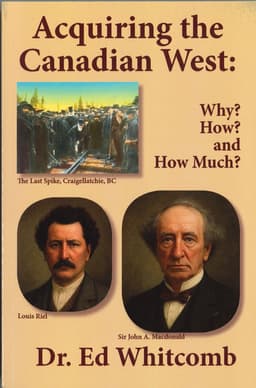
Acquiring the Canadian West: Why? How? And How Much?, 2025
By Ed Whitcomb
Buy the book: https://www.indigo.ca/products/acquiring-the-canadian-west
Ed Whitcomb’s Acquiring the Canadian West: Why? How? and How Much? describes the Canadian government’s project to construct a transcontinental polity and an integrated national economy in the first two decades after Confederation. Taking in the vast expanse of land stretching from the Upper Great Lakes to the Pacific coast, the book is both a thematic survey of the major historical developments and an appraisal of the cost of the Canadian state’s western policies. Intended to reach a general readership, the author favours a relaxed style and discards the conventional critical apparatus and other trappings of the scholarly monograph. The book is part of a larger educational series published by From Sea to Sea Enterprises featuring standalone short histories of Canada’s provinces (all by Whitcomb) intended to promote Canadian history.1
The preface establishes the author’s personal connection to the settler-colonial society established on the Prairies after 1867. Here Whitcomb describes his motivation to take up the theme as an outcome of his upbringing, education, professional experience, and private interests (x). The “Introduction” and chapters 1, 2, and 3 inaugurate the overarching analytical rubric (why, how, how much?). These pages sketch a general background discussion, take in the purchase of Rupert’s Land, and outline the founding of the Province of Manitoba. Important demographic developments receive due attention, such as the emergence of the Métis people, the establishment of the Selkirk colony at Red River, and the westward migration of land-hungry English-speaking Protestants out of the eastern colonies by mid-century. Whitcomb offers interesting commentary on the early push to extend Canada further west in the wake of the Treaty of Oregon (1846), an important international pact that removed the immediate threat of American expansion into Rupert’s Land. He explains the Doctrine of Discovery, which provided theoretical support to European claims of imperial sovereignty. In this vein, he dwells at some length on the discrepancy between the British concept of sovereignty and the question of Indigenous land title.
Subsequent chapters cover further territorial expansion and the entry of a newly-unified British Columbia. The ceding of land and establishment of reserves under the “numbered” treaty system and the failure on the part of successive federal governments to implement treaty promises span two chapters. An overlong portion of the book details the history of the Canadian Pacific Railway. Two chapters cover the enormous undertaking involved in surveying the railway’s route, and another three investigate the problems of building and financing the line. The land-grant system, intended to populate the western lands rapidly with hardy farming folk, is the focus of the penultimate chapter. The book closes with an overview of the violent confrontation between starved and aggrieved Indigenous peoples and the Canadian state that culminated in the Northwest Rebellion of 1885.
Throughout, Whitcomb sketches a fundamentally colonial process that historians have long concluded was unjust and duplicitous in its rationale and execution. The author takes normative positions on the impact of colonization on Indigenous people and the Canadian state’s central complicity in this process. The two chapters devoted to examining the uneven and deceitful negotiations that led to the Numbered Treaties feature sensitive assessments of this calamitous period, including unflinching accounts of official starvation policies, human-caused demographic declines among First Nations communities, government failures to respect basic treaty obligations, and the deepening of assimilationist thinking among policymakers. These passages are the standout feature of Whitcomb’s book.
As an exercise in popular history, intended for public school students and non-specialist readers, Acquiring the Canadian West ultimately fails to live up to its stated goal of informing a general readership about Canada’s history (12). Most critically the core argument does not convince. The author resolves his analysis on the rather insipid inference that the “acquisition” of the West was, on balance, a costly but tremendous “achievement” (5). Later, Whitcomb doubles-down on this assessment, writing that “[a]cquiring the Canadian West was one of the greatest achievements of any people at any time” (193). This effusive conclusion sounds dissonant against the agonizing and as-yet-unsettled colonial struggle the book relates. Moreover, Whitcomb’s cost accounting (drawn mainly from federal Sessional Papers), which appears in textual passages at the end of the chapters, is a strategy ill-designed to appeal to the uninformed casual reader seeking clear and factual historical information on the extension of the Canadian state to the Pacific Ocean. Dollar amounts are strewn liberally in-text, often without helpful comparatives. It is only the most committed reader who will slog through these lines and attempt to make sense of them and, unfortunately, even that reader will be left wondering what the point is. Taken together, this is doubtful conceptual ground on which to anchor a study of what was essentially an act of aggressive colonial expansion in service of capital’s relentless search for value in the Canadian West.
The author makes frequent use of the editorial pen. Understandably skeptical of federal motives, Whitcomb is nevertheless compelled to further inform readers that the federal Liberals were just as, if not more, complicit in the colonial schemes as the Conservatives (81-82). At the same time, considerable effort is made to recuperate John A. Macdonald’s beleaguered reputation as a nemesis of Indigenous people and a leading proponent of the coast-to-coast scheme (4-5), complete with splenetic remarks on the removal of statues commemorating Canada’s founding architect (82). Whitcomb predicts a reputational “rebalancing” (5) as Canadians grapple with the fallout of the current American trade war and come to appreciate the nation-building value of Macdonald’s National Policy.
While several critical studies of colonialism appear in the book’s bibliography, Whitcomb does not introduce prospective readers to important theoretical developments in postcolonial historiography. Indeed, the author’s preoccupations, noted above, harken to an older national history. (The frontispiece with the full lyrics to Gordon Lightfoot’s centennial-year ballad, the “Canadian Railroad Trilogy,” suggests a determination to connect with the nationalist themes.) To be sure, Whitcomb does not shrink from a “warts-and-all” account of Canada’s Western colonialism. But the thematic content and organization of the book, along with its central contention about the acquisition of the West as a proud achievement, suggest the author’s lack of affinity with historiographical and theoretical innovations that have moved well beyond the colony-to-nation framework. Though the book is “not for a university class” (12), contemporary general readers would surely benefit from exposure to the latest advances in research on Canada’s colonial history.
The book also features several exasperating errors. Typos, muddled formatting, and incorrect dates are sprinkled throughout. Factual discrepancies and ambiguous phrasing are left to stand. A striking example of the latter appears on page 73, where the author writes that “Long before 1867, civil servants like Duncan Campbell Scott were arguing that First Nations were ‘savages’ who had to be ‘civilized by the colonial government.’” For all his appalling racism and well-documented bureaucratic and literary offenses, Scott (1862-1947) cannot be faulted for devising pre-Confederation colonial policies.
Academic historians, public historians, and history teachers have long been concerned that Canada’s story reach those unacquainted with its complexities. The history of Canada has much to teach and can indeed equip us with the critical tools to confront modern problems thoughtfully and rationally. On that score, Acquiring the Canadian West is to be commended for taking up this challenge with conviction. Unfortunately, the book falls considerably short of this worthy goal. Rather than synthesizing the latest research on colonialism and capitalism in the Canadian West, making it accessible to general readers, and thereby helping them form judicious opinions on historically relevant contemporary issues, Whitcomb uses the opportunity to advance a retrograde nation-building story. The cost-accounting approach, likewise, has little to offer casual readers.
Todd Stubbs
Lakehead University